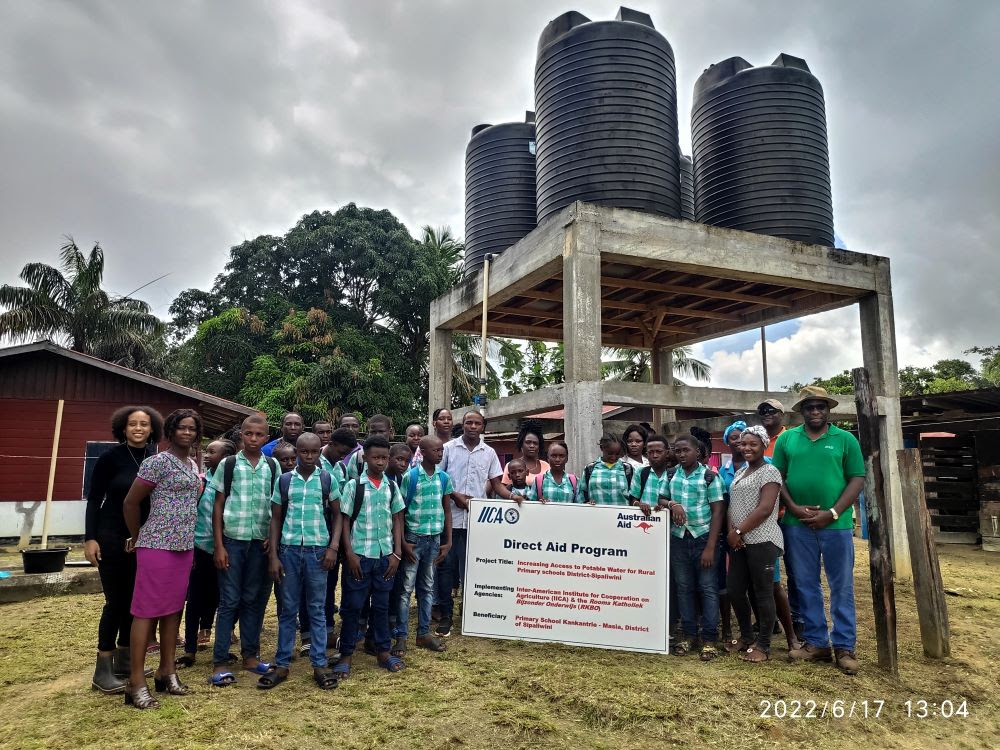
Paramaribo, 29 June, 2022. Three primary schools located in rural villages in the hinterland of Suriname are today benefitting from water supplies through the installation of water harvesting and storage systems. The population of approximately six hundred and ninety-two students, and thirty-one teachers distributed over the three schools in the villages of Jaw-Jaw, Masia Kriki, and Ligorio, in the District of Brokopondo, Suriname, were each the beneficiaries of 4000-gallon storage capacity systems with accompanying distribution, and water harvesting systems. In addition to supplying the needs of the targeted schools, the systems will also serve the complimentary water needs of the other non-school residents in the three villages. The villages are of indigenous Maroon ethnic populations.
In recent years, many villages in the hinterland of Suriname have been facing two major problems which impact their supply of potable water sources. The extensive extractive industries of gold mining and timber, whether legal or illegal, has caused severe mercury contamination of many riverine and ground water sources in the case of gold, and excessive turbidity of these water sources as result of both gold mining and timber extraction activities. These are having serious negative consequences for the health of the indigenous communities who rely on these water sources for drinking, cooking, and personal hygiene. This problem is exacerbated with the emergence of climate change and the increased frequency of extended drought conditions in the hinterland, and which due to the remoteness of these villages, have no alternative means of sourcing potable water and must utilized the contaminated sources.
This intervention was made possible through a small grant provided under the Australian Direct Aid Programme (DAP), managed by the Australian High Commission in Trinidad and Tobago, with counterpart funding from Inter-American Institute from Cooperation on Agriculture (IICA), and the Rooms Katholiek Byzonder Onderwijs Foundation (RKBO) [translated: Roman Catholic Special Education Foundation]. The beneficiary schools fall under the management of the RKBO and were identified and targeted for support on the behest of the Foundation.
Over the last 5 years, the Australian government’s DAP through IICA, has provided nearly USD200,000 towards the strengthening permapiculture, improving access to potable water through establishment of rainwater harvesting systems, and installation of modern sanitation infrastructure, which has in turn directly benefited 17 villages in the Hinterland of Suriname. The new water harvesting, and storage systems of this latest DAP project intervention was formally handed over to the local authorities and beneficiaries at a ceremony held for this purpose on June 17, 2022.
Monday, August 17


Trending
- Government Launches 2026 Back-to-School Voucher for Every Eligible Child as Cost-of-Living Support Continues
- Emmy Award-Winning Journalist Jego Armstrong Announced as Featured Lecturer for 28 th PrimeMinister’s Independence Lecture Series
- NATIONAL DIGITAL HEALTH INFORMATION SYSTEM SUCCESSFULLY DEPLOYED AT JNF GENERAL HOSPITAL
- SCHOOL BUS FLEET STRENGTHENED AHEAD OF NEW ACADEMIC YEAR
- Saint Kitts and Nevis Champions Human Rights, Youth Leadership and Peace at 20th International Human Rights Summit
- Prime Minister Drew Urges Taiwan Scholarship Recipients To Return Home Ready to Contribute To National Development
- EDUCATION MINISTER WELCOMES LARGEST-EVER TAIWAN SCHOLARSHIP COHORT FOR SAINT KITTS AND NEVIS
- St. Kitts and Nevis Pursues New Medical Scholarship Pathway Through Taiwan Partnership