

Washington, D.C., June 30, 2026 — The Federation of Saint Kitts and Nevis
reaffirmed its commitment to regional cooperation, sustainable development, and
economic integration through its active participation in the 31st Ordinary Meeting of
the Ministerial Council of the Association of Caribbean States (ACS), held in
Panama City, Republic of Panama, from June 20–21, 2026.
The Federation was represented by Her Excellency Ambassador Jacinth Henry-Martin,
Head of Delegation, accompanied by Foreign Service Officer Ms. Ticoya Gilbert. The
Ministerial Meeting formed part of Panama’s High-Level Week commemorating the
Bicentennial of the Amphictyonic Congress and preceded the 56th Regular Session of
the Organization of American States (OAS) General Assembly.
A key feature of the meeting was the adoption of the ACS Strategic Plan 2035, the first
comprehensive long-term strategic framework in the organization’s 31-year history. The
Strategic Plan establishes five priority areas for regional action: protection of the
Caribbean Sea, trade and external economic relations, climate justice-based disaster risk
reduction, transport and connectivity, and sustainable tourism.
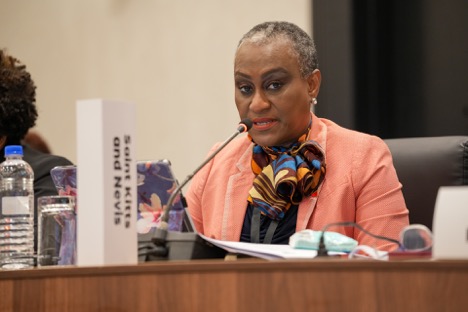
Her Excellency Ambassador Jacinth Henry-Martin O.B.E delivering the presentation on behalf of Saint
Kitts and Nevis at the 31st Ordinary Meeting of the Ministerial Council of the Association of Caribbean
States (ACS) in Panama
During the Ministerial Council, Ambassador Henry-Martin presented the Report of the
Chair of the Special Committee on Trade Development and External Economic
Relations, outlining the significant progress achieved under the Committee’s 2026 Work
Programme.
The report highlighted initiatives aimed at strengthening trade, enhancing the
competitiveness of micro, small and medium-sized enterprises (MSMEs), promoting
investment, advancing digital commerce, and deepening economic cooperation across
the Greater Caribbean.
In her presentation, Ambassador Henry-Martin emphasized the importance of
delivering practical outcomes that benefit the people of the region, stating:
“The Directorate remains committed to delivering tangible value to ACS Member
States through the implementation of its Trade Work Programme. Working closely
with regional and international partners, we have continued to pursue initiatives that
strengthen institutional capacity, support entrepreneurship, promote investment, and
facilitate greater economic cooperation throughout the Greater Caribbean.”
The Ministerial Council also underscored the importance of multilateralism, solidarity,
and collective action in addressing the complex challenges facing the Greater Caribbean.
Discussions focused on climate resilience, sustainable development, disaster risk
reduction, regional connectivity, trade, and resource mobilization, while reaffirming the
value of regional organizations in responding to shared priorities.
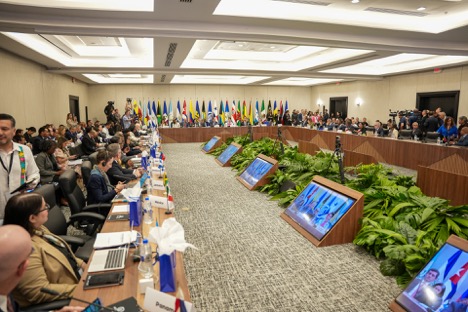
31st Ordinary Meeting of the Ministerial Council of the Association of Caribbean States (ACS) in
Panama
In recognition of the Federation’s continued leadership and constructive engagement
within the Association, Saint Kitts and Nevis was elected Vice Chair of the ACS
Special Committee on Sustainable Tourism for the upcoming term. This
appointment reflects the confidence of Member States in the Federation’s commitment
to promoting sustainable tourism as a catalyst for inclusive economic growth and
regional resilience.
The meeting further highlighted expanding partnerships with international
organizations and development partners, including the Ibero-American General
Secretariat (SEGIB), Spain, the United Arab Emirates, the Gulf Cooperation Council,
and the OECD. These partnerships will support priority initiatives in renewable energy,
climate resilience, investment, digital transformation, the blue economy, and capacity-
building for Small Island Developing States.
The Federation of Saint Kitts and Nevis welcomes the outcomes of the 31st Ordinary
Meeting of the ACS Ministerial Council and remains steadfast in its commitment to
working with regional and international partners to foster sustainable development,
deepen economic integration, strengthen resilience, and advance the shared prosperity
of the Greater Caribbean.
-END-